Fundamental Geometric Concepts
- Angle- a figure formed by two rays with same initial point. The initial point is
its vertex and the two rays are its arms or sides.
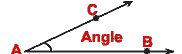
- Type of angle:
Acute angle -an angle whose measure lies between 0° and 90°.
Right angle -an angle whose measure is 90°.
Obtuse angle -an angle whose measure lies between 90° and 180°.
Straight angle -an angle whose measure is 180°.
Reflex angle -an angle whose measure lies between 180° and 360°.
- Types of angles:
Adjacent angles -two angles that have a common vertex,
a common arm and their other arms lie on either side of the common arm.
Linear pair -two adjacent angles whose exterior arms are
in a straight line. Thus if two adjacent angles form a linear pair, then their sum is 180°.
Complementary angles -two angles whose sum of measures is 90°.
Supplementary angles -two angles whose sum of measures is 180°.
- Sum of angles at a point = 360°.
- Sum of angles at a point on a straight line = 180°.
- If the sum of two adjacent angles is 180°, then their exterior arms are in a straight line.
- If two straight lines intersect, then vertically opposite angles are equal.
- Transversal -a line that interests two (or more) lines in a plane at distinct points.
- Properties of angles associated with parallel lines
If a transversal meets two parallel lines, then:
corresponding angles are equal.
alternate angles are equal.
co-interior angles are supplementary.
- Conditions of parallelism
If two lines are cut by a transversal such that a pair of:
corresponding angles is equal, then the lines are parallel.
alternate angles is equal, then the lines are parallel.
co-interior angles is supplementary, then the lines are parallel.
- If two lines are parallel to a third line, then the lines are themselves parallel.
Exercise
- Two angles are complementary and one angle is 10° less than three times the other, find the angles.
- Two supplementary angles are in the ratio 2:7, find the complement of the smaller angle.
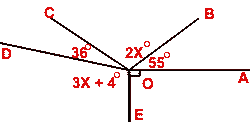
- From the following diagram, find the value of x and hence complete the following:
(i)  AOC =...
(ii) DOE =...
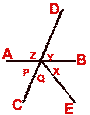
- In the figure below, AB and CD are straight lines. Find
(i) x, y and z if x = p and q = 80°
(ii) p if y : z = 2 : 3
(iii) z if p : q : x = 2 : 3 : 1
(iv) x if y = 40° and q = 2p +10°.
- Find the measure of each lettered angle in the following figures :
(i) 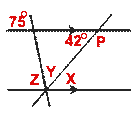 (ii)
(ii) 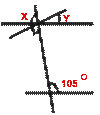
(iii) 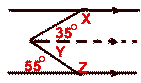
- Find the value of x from the following sketches :
(i) 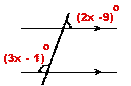 (ii)
(ii) 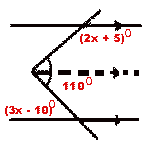
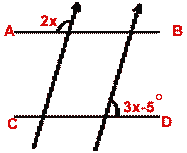
- In the following figure, find the value of x so that the lines AB
and CD may be parallel.
Answers
1. 25°, 65°
2. 40°, 140°, 50°
3. 35°
(i) 125°
(ii) 109°
4. (i) x = 50°, y = 50°, z = 130°
(ii) 72° (iii) 120° (iv) 50°
5. (i) x = 42°, y = 63°, z = 75°, p = 138°
(ii) x = 75°, y = 15°
(iii) x = 145°,y = 55°, z = 125°
6. (i) 38 (ii) 23
7. 37°