Operations on Sets
- The union of sets A and B, written as A
 B, is the set consisting of all elements which belong to either A or B or both.
- If A is any set, then A
 = A,
AA = A, A
= A,
AA = A, A = .
= .
- The intersection of sets A and B, written as A
 B is the
set consisting of all the elements which belong to both A and B.
B is the
set consisting of all the elements which belong to both A and B.
- If A is any set, then A = ,
AA = A,
A = A.
- n(AB) =
n(A) +n(B) -n(AB).
- If A and B are two sets, then difference of A and B is
the set A -B consisting of all the elements which are elements of A but are not elements of B.
- Complement of a set A, written as A' or AC is the set consisting of all the elements of
which do not belong to A.
Thus A' = {x | x  and x
and x A}.
A}.
- If A is any set, then AA' = , AA' =
, n(A) +n(A') = n().
- In Venn diagrams, sets are represented by closed figures
like rectangle, circle, oval. Elements of the set are shown as points inside
this figure. Usually the universal set is denoted by rectangle and its subsets
by closed curves (circles etc.) within this rectangle.
Exercise
- Let A = {-5, -3, 0, 3, 5}, B = { -4, -2, 0, 2, 4} and
= { -5, -4, -3, -2, -1, 0, 1, 2, 3, 4, 5}
(i) Find AB
(ii) Find AB
(iii) Verify that n(AB) = n(A) +n(B) -n(AB)
(iv) Find A'
(v) Verify that n(A) +n(A') = n()
(vi) Find B'
(vii) Verify that n(B) +n(B') = n()
(viii) Find AA' and AA'
(ix) Find BB' and BB'
(x) Find (AB)' and A'B'. Verify that they are equal.
(xi) Find (AB)' and A'B'.
Verify that they are equal.
(xii) Find A -B and B -A. Are they equal?
- Let A = {x | x is an even natural number less than 20} and
B = {x| x is a multiple of 3 less than 20}
Represent A and B by Venn diagrams. Hence find AB and AB.
- Let A = {students who like cricket} and B = {students who like tennis}.
Let n(A) = 20, n(B) = 15 and n(AB) = 5. Find n(AB).
- Let n()
= 50, n(A) = 15, n(B) = 13, n(AB) = 10.
Find n(A'), n(B'), n(AB).
- In a city, 50% people read newspaper A, 45% read newspaper B and 25% read neither
A nor B. How many individuals read both the newspapers A as well as B?
- Let = {triangles}, I = {isosceles triangles}, E = {equilateral triangles},
R = {right angled triangles} and P = {obtuse angled triangles}.
(i) Draw a Venn diagram to show these sets in their correct relationship.
(ii) Shade the region representing IR and write
the measures of the angles of the triangles of this region.
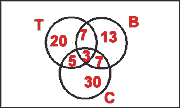
- The students of a certain school have a choice of three games: Tennis, Badminton and Cricket. The following table gives
the percentage of students who play some or all the games:
| Games |
Tennis |
Badminton |
Tennis and Badminton |
Badminton and Cricket |
Cricket and Tennis |
Cricket only |
All Games |
| % of students |
35 |
30 |
10 |
10 |
8 |
30 |
3 |
Draw a Venn diagram and use it to determine the percentage of students who
(i) play Tennis only
(ii) play Badminton only
(iii) play Cricket
(iv) do not play any of the games.
Answers
1.(i) {-5, -4, -3, -2, 0, 2, 3, 4, 5}
(ii) {0}
(iv) {-4, -2, -1, 1, 2, 4}
(vi) {-5, -3, -1, 1, 3, 5}
(viii) AA' = ,
A A' =
(ix) BB' = ,
BB' =
(x) {-1, 1}
(x) {-5, -4, -3, -2, -1, 1, 2, 3, 4, 5}
(xii) A -B = {-5, -3, 3, 5} and B -A = {-4, -2, 2, 4}. They are not equal.
2. A = {2, 4, 6, 8, 10, 12, 14, 16, 18} and B = {3, 6, 9, 12, 15, 18}.
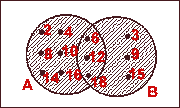
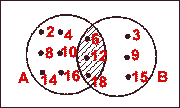
AB = {2, 4, 6, 8, 10,12, 14, 16, 18, 3, 9, 15}
AB = {6, 12, 18}
3.
nbsp;nbsp; 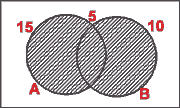
n(AB) = 15 +5 +10 = 30
4. n(A') = 35, n(B') = 37, n(AB) = 18
5. 20%
6. (i)
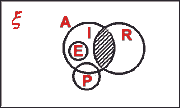
(ii) 45°, 45°, 90°
7. (i) 20%
(ii) 13%
(iii) 45%
(iv) 15%.