Relations and Mappings
- Relation is an association between two objects.
- The concept of relation between two sets by finding the relation (rule of
association) and drawing arrows from left hand side to right hand side.
- Mapping is an association between two sets A and B such that each element
of A is associated with a unique element of B. So, "there must be an answer,
and this answer should be unique".
- An ordered pair (a, b) is a pair of objects which occur in a
particular order.
- Relations and mappings can also be represented by a set of ordered pairs
and vice versa.
- Mappings are also called functions, usually denoted by letters f,g
etc. The set of images is called range and the set of pre images is called
domain of a function.
- A function may be written in roster form (set of ordered pairs) or as
arrow diagram or in equation form (formula).
Exercise
- Write true or false:
(i) An ordered pair is a pair of objects taken in any order.
(ii) (2, 3) = (3, 2)
(iii) {2, 3} = (2, 3)
(iv) If (x, 2) = (3, y) then x = 3, y = 2
(v) If (x +1, y +1) = (5, 6) then x = 4, y = 5
(vi) The relation {(0, 0), (0, 1), (0, 2)} is a mapping.
(vii) The relation {(0, 0), (1, 0), (2, 0)} is a mapping.
(viii) In a function each element has a unique image.
(ix) Domain is the set of preimages.
(x) Range is the set of images.
- Consider R =

(i) Is it a mapping? If yes, write it in equation form. Hence evaluate f(5).
(ii) If f(x) = 37/6, find x.
(iii) What is the domain?
(iv) What is the range?
- Consider the following arrow diagram:
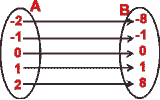
(i) Is it a function? Write it in equation form.
(ii) List the elements of this function.
- Given f : x
 1/x where x
 {integral multiples of 6}
(i) What is the range of this function?
(ii) Find f(18).
(iii) If f(x) = 18, find x.
- Consider the following diagram:
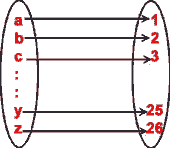
(i) Is it a mapping? Write in roster form.
(ii) Find the image of h.
(iii) Find the preimage of 24.
Answers
1. (i) F
(ii) F
(iii) F
(iv) T
(v) T
(vi) F
(vii) T
(viii) T
(ix) T
(x) T
2. (i) Yes; f(x) = x +1/x; f(5) = 26/5
(ii) f(x) = 37/6 = 6 +1/6, so x = 6
(iii) Domain = {1, 2,.., 10}
(iv) Range = 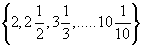
3. (i) Yes; f(x) = x³
(ii) {(-2, -8), (-1, -1), (0, 0), (1, 1), (2, 8)}.
4. (i) {even integers}
(ii) 6
(iii) 54
5. (i) Yes; {(a, 1), (b, 2),....., (y, 25), (z, 26)}
(ii) 8
(iii) x