Method of Intervals
Consider the sign of the expression
f(x) = (x -a1)(x -a2) ... (x -an) where a1
< a2 < ... < an.

On the real number line, mark points a1, a2, ...,
a n. Start with a positive sign for x > an; -ve for an
-1 < x < an; and then alternating +ve and -ve signs. The
logic is that when x> an; all factors x -a1, x -a2,
..., x -a n are +ve and hence f(x) is +ve; when an-1 < x <
an, only one factor x -an is -ve, and so f(x) is -ve, and so on.
Quadratic fractions and their range
Expressions of the kind (a x² +b x +c)/(p x² +q x +r), where x is any real
number, are called quadratic fractions.
Their range can easily be found by putting
(a x² +b x +c)/(p x² +q x +r) = y
=> a x² +b x +c = p y x² +q x y +r y
=> x² (a -p y) +x (b -q y) +(c -r y) = 0
Since the value of x is real, discriminant of this equation in x must be non-negative
=> (b -q y)² -4 (a -p y)(c -r y) = 0.
This inequality yields range of y.
Illustrative Examples
Example
Solve: x (x -1)(x -2)(x -3) > 0.

Solution
Mark points 0, 1, 2, 3 on real line. By method of intervals, we see that
given expression is +ve when x > 3 or 1 < x < 2 or x < 0.
Thus required solutions set is {x < 0; 1 < x < 2; x > 3}.
Example
Solve 1/x < 1.
Solution
Do not fall into this trap: (1/x) < 1 => x > 1,
because we cant multiply by negative quantity without changing the sign of
inequality.
Correct solution is:
Since x² > 0 for all real x, x  0.
0.
1/x < 1 => (1/x) x² < x² =>
x < x² => x² -x > 0
=> x (x -1) > 0 => x < 0 or x > 1, which is the required solution.
Example
For what values of a is the inequality (x² + a x -2)/(x² -x +1) < 2
satisfied for all real values of x?
Solution
(x² +a x -2)/(x² -x + 1) < 2
=> (x² +a x -2)/(x² -x +1) -2 < 0
=> (x² +a x -2 -2 x² +2 x -2)/(x² -x + 1) < 0
=> [-x² +x (a +2) -4]/(x² -x +1) < 0
=> -x² -x (a +2) -4 > 0 (as
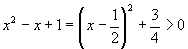 for all real x)
=> x² -x (a +2) +4 > 0
Now the expression x² -x (a +2) +4 is positive for all real x if
 < 0 (as coeff of x² = 1 > 0)
=> [-(a +2)]² -4. 1. 4 < 0 => a² +4 a +4 -16 < 0
=> a² +4 a -12 < 0 => (a +6)(a -2) < 0
=> -6 < a < 2, which is the required range for a.
Example
Show that for all real values of x, the expression (x² -2x +4)/(x² +2x +4)
has greatest value 3 and least value 1/3.
Solution
Let (x² -2 x +4)/(x² +2 x +4) = y
=> x² -2 x +4 = x² y +2 x y +4 y
=> x² (1 -y) -2 x (1 +y) +4 (1 -y) = 0.
Since x is real, discriminant of this quadratic equation in x must be non-negative
=> = b² -4 a c = 0
=> [-2 (1 +y)]² -4. (1 -y). 4 (1 -y)  0
0
=> 4 [1 +y² +2 y -4 (1 +y² -2 y)] 0
=> -3 y² +10 y -3 = 0 => 3 y² -10 y +3 = 0
=> (3 y -1)(y -3) ; 0 => 1  y 3
y 3
=> 1/3 (x² -2 x +4)/(x² +2 x +4)
3 for all real x
Thus the greatest value of given quadratic fraction is 3 and least value is 1/3.
Exercise
- Solve: (i) x³ -3 x² -x +3 < 0
(ii) x4 -5 x² +4 0
- Solve :
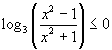
- Find all real values of x which satisfy
(i) x³ (x -1)(x -2)² > 0
(ii) x² (x -1)(x -2) 0
- Solve : (x² +6 x -11)/(x + 3) < -1
- Solve : (x² -3 x +240/(x² -3 x +3) < 4
- Find the range of values of x for which (x² +x + 1)/(x +1) < 1/3, x being real.
- Find the set of all x for which 2 x/(2 x² +5 x +2) > 1/(x+1)
- Let y =
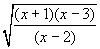 Find all the real values of x for which y takes real values.
- Find all integral values of x for which (5 x -1) < (x + 1)² < 7 x -3
- Solve (i)
 (ii)
(ii) 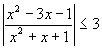
- If x is real, show that (x² -x +1)/(x² +x +1) takes values from 1/3 to 3.
- If x be real, show that the value of (x -1)(x +3)]/[(x -2)(x +4)] cannot
lie between 4/9 and 1.
- If for real values of x, the greatest value of (x² -x +a)/(x² +x +a) is
3, then prove that value of a cannot be less than 1.
- Show the expression (2x² +4x +1)/(x² +4x +2) can have any real value if x
is real.
- Show that if x is real, the expression (x² -bc)/(2x -b -c) has no real
values between b and c.
- Find the minimum and maximum values of (x² -1)/(x² +1). Is maximum value obtained?
- Let f(x) =(
 x² +6 x -8)/(
+6 x -8x²). Find the interval of values of a for which f(x) takes
all real values for real values of x.
x² +6 x -8)/(
+6 x -8x²). Find the interval of values of a for which f(x) takes
all real values for real values of x.
Answers
1. (i) x < -1 or 1 < x < 3
(ii) x -2 or -1 x
1 or x 2
2. x < -1 or x > 1
3. (i) x < 0 or x > 1, x 2
(ii) x = 0 or 1 x 2
4. x < -8 or -3 < x < 1
5. x < -1 or x > 4
6. -1 < x < -1/2
7. -2 < x < -1 or -2/3 < x < 1/2
8. -1 x < 2 or x > 3
9. x = 3
10. (i) All real numbers
(ii) x -2 or x -1
16. -1, 1; No
17. 2
14