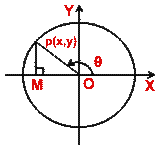
x = r cos
 , y = r sin
,0
, y = r sin
,0  < 2
< 2  represent the circle x² +y²
= r², where is called parameter and the point P
(r cos , r sin ) is called the point
" " on the circle x² +y² = r².
represent the circle x² +y²
= r², where is called parameter and the point P
(r cos , r sin ) is called the point
" " on the circle x² +y² = r².
x = r cos , y = r sin
,0
< 2 represent the circle x² +y²
= r², where is called parameter and the point P
(r cos , r sin ) is called the point
" " on the circle x² +y² = r².
Every point P on the circle can be represented as
x = h + r cos , y = k + r
sin , 0 < 2
Thus, x = h + r cos , y = k + r sin
, 0
< 2 , represent the circle (x -h)² +(y -k)² = r².
is called parameter and the point (h +r cos ,
k +r sin ) is called the point " " on
this circle.
Find the parametric equations of the circle x² +y² = 5
The given circle is x² + y² = 5
We know that the parametric equations of the circle x² +y² = r² are
x = r cos , y = r sin
, 0 < 2
The given circle is comparable with x² +y² = r², here
r =  5
5
Therefore, the parametric equations of the given circle x² +y² = 5 are
x = 5cos , y =
5 sin , 0
< 2
Find the cartesian equations of the curves x = p +c cos
, y = q +c sin , where
is parameter. Do these equations represent a circle? If
so, find center and radius.
Given x = p +c cos ,
y = q + c sin
=> x -p = c cos ,
y -q = c sin
To eliminate the parameter , on squaring and adding these
equations, we get
(x -p)² + (y -q)² = c² (cos²
+sin² )
=> (x -p)² +(y -q)² = c²,
which represents a circle with center (p, q) and radius = | c |.
, y = 2 sin , y = 2 +5 sin 7cos , y = 4 +7
sin , is parameter. Do these equations represent
circles? If so, find center and radius.13 cos , y =
13 sin , 0
< 2 , y = -3 +6 sin
, 0 < 2
, y = 3 +5 sin
, 0 < 2
, y = sin
, 0 < 2
, y = a +| a
| sin , 0 < 2
(p²
+q²) cos , y = -p/2 + (1/2)(p²
+q²) sin , 0
< 2 7