d =| ax1 +by1 +c|/[
 (a² +b²)]
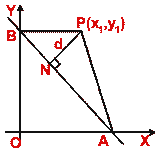
The perpendicular distance d of a point P (x 1, y 1) from the line
ax +by +c = 0 is given by
d =| ax1
+by1 +c|/[(a² +b²)]
Find the equation of a straight line, with a positive gradient, which passes through the point (-5, 0) and is at a perpendicular distance of 3 units from the origin.
Let m (> 0) be the gradient of the line, then any line through (-5,
0) and with gradient m is
y -0 = m(x +5) i.e. mx -y +5m = 0 ...(i)
It will be the required line if its perpendicular distance from origin (0, 0) is 3 units
=> |m.0 -0 +5 m| /[(m² +(-1)²)] = 3
=> | 5 m | = 3 [m² +1]
=> 25 m² = 9 (m² +1) => 16 m² = 9
=> m = 3/4 (m > 0)
Substituting this value of m in (i), the equation of the required line is
(3/4) x -y + 5.3/4 = 0 or 3 x -4 y +15 = 0
Find the distance between the lines 3 x -4 y +7 = 0 and 6 x -8 y = 18.
The given lines are
3 x -4 y +7 = 0 ...(i)
and 6 x -8 y -21 = 0 ...(ii)
We note that the slope of (ii) = - 6/(-8) = 3/4 = the slope of (i)
=> the given lines are parallel.
To find distance between these lines, we choose a point on (i).
On putting x = 0 in (i), we get -4y +7 = 0 => y = 7/4
Thus (0, 7/4) is a point on (i).
Required distance between given parallel lines
= perpendicular distance from (0, 7/4) to the line (ii)
=
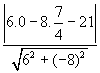 =
|-35 | =
=
|-35 | =  units
units
 ABC.13 units
(ii) 1/5 units
(iii) [h² +k²] units2 units
3. 2 units
4. 12, -2813 units, 17 sq. units2] units
ABC.13 units
(ii) 1/5 units
(iii) [h² +k²] units2 units
3. 2 units
4. 12, -2813 units, 17 sq. units2] units