n²) denote the sum of first n
natural numbers, then
n²) denote the sum of first n
natural numbers, thenSn = 1 +2 +3 +... +n
This is an A.P. with a = 1, d = 1 and n terms.
Using formula Sn = n(a +l)/2,
Sn = n(1 +n)/2 = n(n +1)/2 or
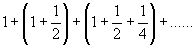
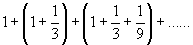
n= n(n +1)/2A series each term of which is formed by multiplying the corresponding
terms of an A.P. and G.P. is called arithmetico-geometric series.
The general or standard form of such a series is a, (a +d) r, (a +2 d) r², ...
Let Sn (or n²) denote the sum of first n
natural numbers, then
Sn = 1 +2 +3 +... +n
This is an A.P. with a = 1, d = 1 and n terms.
Using formula Sn = n(a +l)/2,
Sn = n(1 +n)/2 = n(n +1)/2 or
n= n(n +1)/2
Let Sn (or n²) denote the sum of
squares of the first n natural numbers, then
Sn = 1² +2² +3² +... +n².
Consider the identity x³ -(x -1)³ = 3 x² -3 x +1 ...(i)
Putting x = 1, 2, 3, ..., n in (i), we get
1³ -0³ = 3. 1² -3. 1 +1
2³ -1³ = 3. 2² -3. 2 +1
3³ -2³ = 3. 3² -3. 3 +1
..........................................
..........................................
n³ -(n -1)³ = 3. n² -3. n +1
Adding column wise, we get
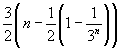
n³ -0³ = 3(1² +2² +... +n²) -3 (1 +2 +... +n) + n
n³ = 3 n² -3 n +n
therefore n² = n(n +1)(2n +1)/6
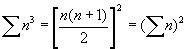
Let Sn or n³ denote the sum of the
cubes of the first n natural numbers.
Then Sn = 1³ +2³ +3³ +... +n³.
Consider the identity x4 -(x -1)4 = 4 x³ -6 x² +4 x -1,
we get
In some series, the differences of successive terms (Tn and Tn -1) may be in some particular sequence -A.P., G.P., A.G.P. etc. In these cases, the sum of series can be found by a technique known as "method of differences".
Sum to n terms the series
2 +5 x +8 x² +11 x³ +..., |x| < 1. Deduce the sum to infinity.
The given series is formed by multiplying corresponding terms of A.P. 2, 5,
8, 11, ... and G.P. 1, x, x², x³, ...
Hence n th term of given arithmetico-geometric series is
[2 +(n -1) 3]. xn -1 = (3 n -1) xn -1
Let Sn = 2 +5 x +8 x² +11 x³ +... +(3 n -4) xn -2 +(3 n -1) xn -1
x Sn = 2 x +5 x² +8 x³
+...
+(3 n -4) xn -1 +(3 n -1) xn
(1 -x) Sn = 2 +(3 x +3 x² +3 x³ +... +3 xn -1) -(3n -1) xn
= 2 +3 x (1 +xn -1)/(1-x)
-(3 n -1) xn
Sn = 2/(1-x) + 3 x (1 +xn -1)/(1-x)² -(3 n -1)
xn/(1-x)
To find limiting sum S, we note that
xn -1, xn => 0, n xn =>  because |x| < 1
Therefore S = 2/(1-x) + 3x/(1 -x)² = (2 + x)/(1 -x)²
Sum to infinity the series 1² +2². x + 3². x² +..., |x| < 1.
Though the given series is not an arithmetico-geometric series, it can be
summed up using a similar method.
Let S = 1 +4 x +9 x² +16 x³ +... x
Sx = x +4 x² + 9 x³ +...
=> (1 -x) S = 1 +3 x +5 x² +17 x³ +...,
which is an arithmetico-geometric series
x (1 -x) S = x +3 x²+ 5 x³ +...
=> (1 -x)² S = 1 +2 x +2 x² +2 x³ +...
= 1 + 2x/(1-x) = (1 +x)/(1-x).
=> S = (1 +x)/(1 -x)³
Find the sum of the series 2. 5 +5. 8 +8. 11 +... to n terms.
This series is formed by multiplying the corresponding terms of sequences
2, 5, 8, ... and 5, 8, 11, ... both of which are A.P.s.
Now nth term of first A.P. = 2 +(n -1)3 = 3n -1
and nth term of second A.P. = 5 +(n -1)3 = 3n +2
Hence nth term of the given series,
Tn = (3 n -1)(3 n +2) = 9 n² +3 n -2
Thus the required sum,
Sn = Tn = (9
n² +3 n -2) = 9 n² +3 n -2 n
= 9 . n (n +1)(2n +1)/6 +3n (n +1)/2 -2 n
= n (6 n² +12 n +2)/2 = n (3 n² +6 n +1)/2
Find the sum of first n terms of the series 1 +(1 +2) +(1 +2 +3) +.........
nth term of the given series,
Tn = 1 +2 +3 +... up to n = n (n +1)/2 = n²/2 +n/2
Sum of first n terms of the given series

=[ n (n +1)/12](2n +1 +3) = n(n +1)(n +2)/6
Find the nth term of series 1 +3 +7 +13 +..., and hence find the sum of first n terms.
Here the differences of successive terms are 2, 4, 6, ... which form an A.P.
Let Tn denote the nth term and Sn denote the sum
of first n terms.
Then Sn = 1 +3 +7 +13 +... +Tn -1 +Tn
Also Sn = 1 +1 +3 +17 +............ +Tn -1 +Tn
0 = 1 +2 +4 +6
+... upto n terms -Tn
Tn = 1 +(2 +4 +6 +... upto n-1 terms)
= 1 + (n -1)[2. 2 +(n -2)2]/2 = n² -n +1
Sn = n²
- n +n
=
n (n +1)(2 n +1)/6 n (n +1)/2 +n
= n [2 n² +3 n +1 -3 (n +1) +6]/6
= n (2n² +4)/6 = n (n²+2)/3
Find the n th term, sum of n terms, and sum to infinity of the series
1/2.5 +1/5.8 +1/8.11+ ...
Tn = 1/ [(n th terms of 2, 5, 8,....)(n th term of 5, 8, 11,...)]
= 1/[(2 +(n -1) 3)(5 +(n -1) 3)]
= 1/ [(3n -1)(3 n +2)]
=
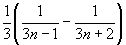
Putting n = 1, 2, 3, ..., n, we get
T1 =

T2 =

.....................
Tn =
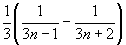
Adding, Sn =
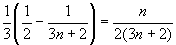
Also sum to infinity =
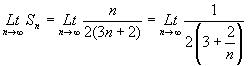
=