
cosec
cot
sec
| Quadrant | I | II | III | IV |
| T-ratios which are +ve | All |
sin cosec |
tan cot |
cos sec |
This table can be memorised with the help of phrase "Add Sugar To Coffee"
| Add | Sugar | To | Coffee |
| All | Sin | Tan | Cos |
| I | II | III | IV |
| Function | Domain |
| sin, cos | all real numbers |
| tan, sec | all real numbers other than
(2 n +1)  /2,
n /2,
n  Z Z |
| cot, cosec | all real numbers other than
n , n Z |
The maximum and minimum values of sin and cos
are +1 and -1 respectively.
Thus, -1  cos
1 and -1 sin 1
cos
1 and -1 sin 1
| Function | Range |
| sin, cos | [-1, 1] |
| tan, cot | any real value |
| sec, cosec | any real value except (-1, 1) |
If tan = -2, find the values of the
remaining trigonometric ratios of .
= -2, find the values of the
remaining trigonometric ratios of .
Given tan = -2 which is - ve, therefore,
lies in second or fourth quadrant.
Also sec² = 1 + tan² = 1 +(-2)² =
5
=> sec = ± 5
5
Two cases arise:
Case I. When lies in the second quadrant, sec
is - ve.
sec = -5 =>
cos = -1/5
sin = (sin/cos).cos
= tan. cos = (-2).(-1/5)
= 2/5
=> cosec = (5)/2
Also tan = -2 => cot
= -1/2
Case II. When lies in the fourth quadrant, sec
is + ve.
sec = 5 =>
cos = 1/5
sin = (sin/cos).cos
= tan. cos = (-2).(1/5)
= -2/5
=> cosec = -(5)/2
Also tan = -2 => cot
= -1/2
Prove that sin = x + 1/x is not
possible for real x.
When x > 0, x +1/x = (x - 1/x)² +2
 2
2
When x < 0, let x = -y where y > 0. Then
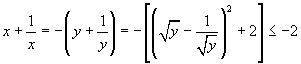
Thus x +1/x 2 or x +1/x
-2
=> sin 2
or sin -2
Also, we know that -1 sin
1
Hence sin = x +1/x is not possible for any real x.
Aliter.
sin = x +1/x => x 2
-sin . x +1 = 0
It is a quadratic in x. As x is real, it has real roots
=> (-sin )² -4. 1. 1
0
(discriminant 0)
=> sin² 4 =>
|sin | 2
=> sin -2 or sin
2
Also we know that 1 sin
-1
Hence sin = x +1/x is not possible for any real x.
Is the equation 2 sin² -cos
+4 = 0 possible?
2 sin² -cos +4 = 0
=> 2 (1 -cos² ) -cos
+4 = 0
=> -2 cos² +cos -6 = 0
=> 2 cos² +cos -6 = 0
=> (2 cos -3)(cos + 2) = 0
=> 2 cos -3 = 0 or cos +2 = 0
=> cos = 3/2 or cos
= -2, both of which are impossible as -1 cos
1.
Hence the equation 2 sin² -cos +4
= 0 is not possible.
/2 < A < < A < 3/2 lie if is positive and tan is
negative and cos are
negative = 4/5 and cos = 3/5 = 2/3 and cos = 1/3 = x
+1/x possible? sec = -1 and
lies in the second quadrant, find sin
and sec . = 12/13 and lies in the
second quadrant, show that +tan = -5. : cos : :
3 : 1, find sin , cos .3/2 , tan A = -3,
cot A = -1/3, sec A = -2, cosec A = 2/3
+cos² = 12, -2 = 3/2, cos
= 1/2 or sin = - 3/2, cos
= 1/2